


Have you ever considered the health of your cells? Most people are little to not at all familiar with the topic of cell health – yet our cells form the foundation of our health! Our entire body consists of around 100 trillion tiny cells that enable all the vital functions we perform consciously and unconsciously every day. Each individual cell is a small marvel where chemical and electrical processes are constantly taking place. For these processes to run smoothly – and for us to feel healthy and fit – it is important that the cells are not hindered in their work.
A possible hindrance for our cells is damaged or useless cell components – so-called ‘cellular waste.’ This ‘waste’ inevitably arises from the activities of the cell and consists of individual cell components such as misfolded proteins or entire cell organelles. In itself, it is not a problem for our health. Because through the cell’s self-cleaning process – called autophagy – this cellular waste is disposed of.
The body’s own recycling system
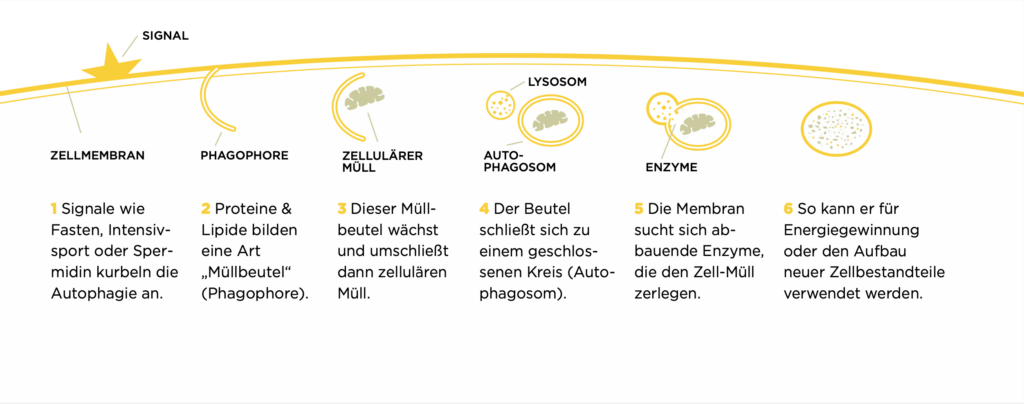
Autophagy refers to the natural process of cleaning, renewing, and regenerating our cells. A highly effective, natural anti-aging process in which damaged or useless cell components are recognized and broken down into the smallest parts. These are then rebuilt or used to generate energy. The cell essentially consumes itself. This allows damage to the cell to be repaired and protects it from premature death. Another plus: the proliferation of healthy cells is promoted!
It is a vital process – a kind of self-cleaning program for the cells. Constant renewal of body cells is crucial for our cell health. Without this cell renewal diseases such as cancer or dementia can develop.
The conclusion: The aging process of the body is naturally slowed down.
Autophagy
How to support the health of your cells
Autophagy is great – but what can you do now to protect your cells, keep them healthy, and slow down your aging process?
Pay attention to healthy sleep
Healthy, sufficient sleep positively affects many processes in the body – including the regeneration of cells! Because while we sleep, our cells can recover and recharge energy. Antioxidants and enzymes that contribute to protecting our cells are also regulated during sleep.
Exercise & healthy nutrition
A healthy lifestyle, balanced nutrition, and regular exercise not only positively impact our overall well-being but also support our cell renewal. Adequate nutrient supply also plays an important role here. You can find more on this topic in this blog post.
Reduce oxidative stress and rely on antioxidants
One of the biggest stress factors for our cells is oxidative stress. An excess of free radicals in the body disrupts important metabolic processes and can cause cell damage. Oxidative stress arises, for example, from lack of sleep, smoking, alcohol, and sugar, but also environmental influences (UV radiation, exhaust fumes, fine dust, heavy metals, etc.).
By avoiding pollutants and supplying yourself with valuable antioxidants , you can protect your cells against oxidative stress!
Boost autophagy through fasting
Your body’s own self-cleaning program via autophagy runs at full speed especially when your body is in a calorie deficit. This means: the body’s need for nutrients is greater than its supply through food. This is the case, for example, when we exercise or fast. Your body then taps into the energy reserves in its own cells. The cells use what they no longer need to generate energy – at the same time, they free themselves from harmful cellular waste through this process. A win-win!
Sources
Infopharm (2015). Reducing facial wrinkles, promoting cell health. Aesthetic Dermatology & Cosmetology, 7(5), 43–43. DOI: 10.1007/s12634-015-0999-9
Madeo F, Eisenberg T, Pietrocola F, Kroemer G. Spermidine in health and disease. Science. 2018 Jan 26;359(6374):eaan2788.
Mallison, Maike/Harbs, Daniel (2021). Burnout begins in the cell. In Burnout Is Out. Germany: Springer Vieweg. in Springer Fachmedien Wiesbaden GmbH. DOI: 10.1007/978-3-658-34660-7_5
Sigrist SJ, Carmona-Gutierrez D, Gupta VK, Bhukel A, Mertel S, Eisenberg T, et al. Spermidine-triggered autophagy ameliorates memory during aging. Autophagy. 2014 Jan;10(1):178–9.
Wirth M, Benson G, Schwarz C, Köbe T, Grittner U, Schmitz D, et al. The effect of spermidine on memory performance in older adults at risk for dementia: A randomized controlled trial. Cortex. 2018 Dec;109:181–8
Mizushima N, Komatsu M. Autophagy: Renovation of Cells and Tissues. Cell. 2011 Nov;147(4):728–41.
Eisenberg T, Abdellatif M, Schroeder S, Primessnig U, Stekovic S, Pendl T, et al. Cardioprotection and lifespan extension by the natural polyamine spermidine. Nat Med. 2016 Dec;22(12):1428– 38.


